Bowel endometriosis treatment in Turkey
If you are searching for bowel endometriosis treatment in Turkey, you have probably already been through a great deal: years of pain, appointments where your symptoms were dismissed, and perhaps a frightening sentence such as “this is too complicated to operate on” or “you may need a permanent colostomy bag.”
I want to start with a message of hope. Bowel endometriosis is a serious and complex form of the disease, but it can be treated, and in many cases it can be treated while protecting your healthy organs and your bowel function. What matters most is who operates and how much experience they have with this specific type of surgery.
What is bowel endometriosis?
Endometriosis is a condition in which tissue similar to the lining of the uterus (the endometrium) grows outside the uterus. This tissue responds to your monthly hormonal cycle: it thickens, breaks down and bleeds, but the blood has nowhere to go. The result is inflammation, scar tissue, adhesions (internal sticking of organs to each other) and pain.
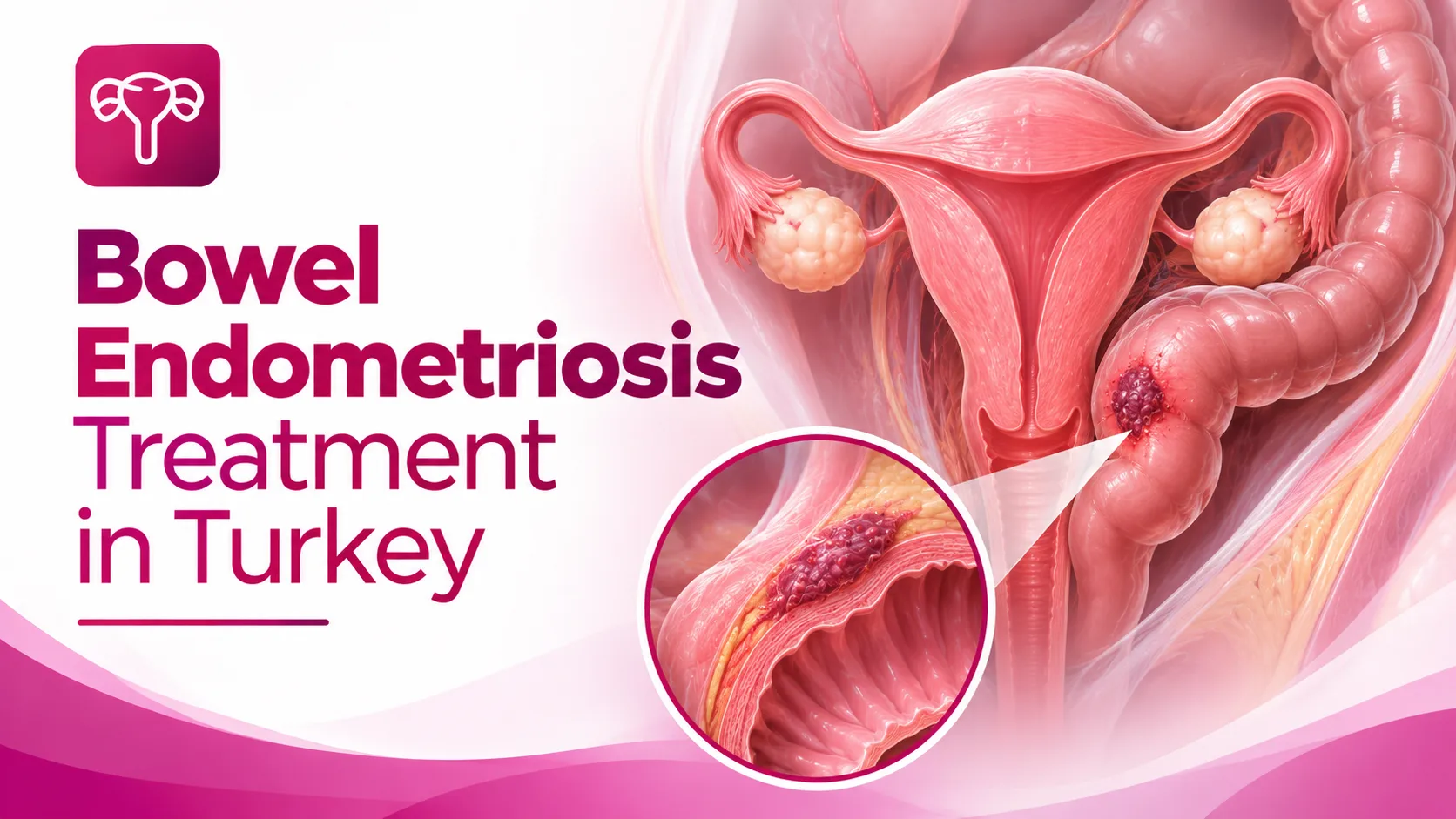
Bowel endometriosis means that this tissue has grown on or into the wall of the intestine. It most often affects the last part of the large bowel, the rectum and the sigmoid colon, which sit right behind the uterus. Less often it involves the small bowel or the appendix.
How common is it?
Endometriosis affects roughly 1 in 10 women of reproductive age. Bowel involvement is found in about 5 to 12 percent of women who have endometriosis. It is considered a form of deep endometriosis, meaning the disease grows into the tissue rather than sitting on the surface. Bowel endometriosis is not cancer, and it is not linked to a higher risk of bowel cancer, but it can seriously affect quality of life and sometimes fertility.
Symptoms of bowel endometriosis
Symptoms vary from woman to woman, and some women have very few. The signs that most often make doctors suspect bowel involvement include:
- Pain when opening your bowels, especially around your period
- Severe period pain that is not controlled by usual painkillers
- Constipation, diarrhoea, or alternating between the two
- Bloating and a swollen abdomen, often worse during menstruation
- Blood in the stool during your period
- A feeling of incomplete emptying or pressure in the rectum
- Pain during sex, particularly deep pain
- Chronic pelvic pain, lower back pain or pain radiating to the legs
- Tiredness and difficulty getting pregnant
Because many of these symptoms look like irritable bowel syndrome, women are sometimes treated for a digestive problem for years. Bowel symptoms alone do not prove that endometriosis has reached the bowel, but when they follow your menstrual cycle, it is worth asking for a specialist assessment.
What causes bowel endometriosis?
The exact cause is still not fully understood. The most widely accepted explanation is retrograde menstruation, where some menstrual blood flows backwards through the fallopian tubes into the pelvis and the cells implant on nearby organs. Other factors probably play a role, including the immune system, genetic predisposition and the fact that the disease depends on oestrogen, the female hormone that drives the menstrual cycle.
None of this is caused by anything you did or did not do. Endometriosis is not a lifestyle problem and it is not “in your head.”
How is bowel endometriosis diagnosed?
A good diagnosis is the foundation of a good surgical plan. Before recommending any operation, I want to know exactly where the disease is, how deep it goes and how many nodules there are.
Medical history and examination
We begin by listening carefully to your symptoms, how they change through your cycle, your previous treatments and any fertility plans. A pelvic examination can reveal tender nodules behind the uterus.
Imaging
- Transvaginal ultrasound performed by an examiner experienced in deep endometriosis can show nodules in the bowel wall.
- Pelvic MRI gives a detailed map of the disease, including its size, its depth in the bowel wall and its distance from the anus. This map helps decide which surgical technique is suitable.
- In selected cases, colonoscopy or other bowel studies may be used, mainly to look at the bowel itself and to rule out other conditions.
If you have already had scans elsewhere, bring or send them. A careful review of existing MRI and ultrasound images is often the first step of an expert surgical evaluation.
Bowel endometriosis treatment options
Medical (hormonal) treatment
Hormonal medications can reduce or stop periods and may calm symptoms. They can be a good option for women with mild symptoms, women who are not ready for surgery, or as part of a longer-term plan. However, medication suppresses the disease; it does not remove an established nodule from the bowel wall. When treatment is stopped, symptoms often return.
When surgery is recommended
Surgery is usually considered when:
- Pain or bowel symptoms are severe and affect daily life
- Medication has not worked or is not tolerated
- The bowel is narrowing, or there is a risk of obstruction
- There is cyclical bleeding from the bowel
- Endometriosis is contributing to difficulty getting pregnant
Why the surgeon’s experience matters
Bowel endometriosis often sits close to important structures: the rectum, the uterus, the ovaries, the ureters (the tubes that carry urine from the kidneys) and the nerves that control bladder and bowel function. Removing it safely requires advanced surgical skills and extensive experience. My goal is to remove the disease as completely as possible whenever it is safe to do so, while preserving healthy organs and bowel function.
Surgical techniques: Shaving, Discoid Excision and Segmental Resection
There is no single operation that suits every patient. Depending on the extent of the disease, we use one of three main techniques. The decision is based on the size of the nodule, how deeply it invades the bowel wall, how much of the bowel’s circumference it involves, how many nodules there are and how far they are from the anus.
Bowel shaving
In bowel shaving, the nodule is carefully peeled or “shaved” off the surface of the bowel wall without removing a piece of the bowel. This is used when the disease is on or in the outer layers of the wall. It is the most conservative option, and when it is appropriate it keeps the bowel intact.
Discoid excision
In discoid excision, a small disc-shaped piece of the bowel wall containing the nodule is removed, and the opening is then closed with stitches or a surgical stapler. It is suitable for selected nodules that are too deep to shave but still limited in size.
Segmental resection
Segmental resection is used for larger or more extensive disease, or when the bowel is significantly narrowed. A short segment of the affected bowel is removed and the two healthy ends are joined together again (an anastomosis), so that the bowel continues to work in the normal way.
Will I need a colostomy bag?
This is the question I hear most often, and it is the fear that frightens women the most. Many patients can undergo surgery without needing a colostomy bag. A permanent colostomy is not the usual outcome of bowel endometriosis surgery. In rare, individually assessed situations, such as a very low join in the rectum, a surgeon may discuss a temporary protective stoma, which is normally reversed after the bowel has healed. We talk through this possibility before the operation, based on your own scans, so that nothing comes as a surprise.
My Approach to bowel endometriosis surgery
I operate on complex endometriosis every day, and my training as a gynecologic oncologic surgeon is highly relevant here. Cancer surgery demands precise dissection close to vital organs, careful handling of the bowel and ureters, and a strong focus on preserving function. These same skills apply directly to deep endometriosis.
My approach rests on a few principles:
- Treat the disease thoroughly. Leaving nodules behind is a common reason for symptoms to continue.
- Preserve what is healthy. The aim is to protect the bowel, the ovaries and, when you want children, your fertility.
- Choose the least aggressive technique that completely treats your disease. Shaving when shaving is enough, resection only when it is truly needed.
- Plan before you arrive. Imaging is reviewed in advance, so that the surgical plan is already clear when we meet.
- Minimally invasive surgery. Whenever possible, I use laparoscopy (keyhole surgery), which means smaller incisions, less pain and usually a faster recovery than open surgery.
Recovery and prognosis after bowel endometriosis surgery
In the hospital
The length of the hospital stay depends on which technique was used. Shaving and discoid excision generally need a shorter stay than segmental resection. In the first days after surgery your diet is increased gradually, you are encouraged to walk early, and the team monitors your pain, bowel activity and wound healing.
Getting back to normal
Most women return to light daily activities within a couple of weeks, but internal healing takes longer. For several weeks you will be advised to avoid heavy lifting and strenuous exercise. Your bowel habits may be slightly irregular at first and usually settle as you heal. Many women describe a major improvement in pain, bloating and bowel symptoms once the disease has been removed.
Will it come back?
Endometriosis is a chronic condition, and recurrence is possible. Thorough removal of the disease lowers the risk, and your doctor may suggest hormonal treatment after surgery to help keep the disease quiet, especially if you are not trying to conceive. Regular follow-up is part of the plan.
Fertility after surgery
If you hope to have children, this should be part of the plan from the very beginning. Surgery can remove the inflammatory environment and restore normal anatomy, which can support natural conception for some women. For others, assisted reproduction such as IVF may be the better route, and the timing relative to surgery is something we decide together.
Why patients choose Istanbul for bowel endometriosis treatment
Turkey, and Istanbul in particular, has become a centre for advanced laparoscopic gynecologic surgery. Patients come from many countries, and I have operated on women from 37 countries. I am a Professor of Obstetrics and Gynecology, hold the ESGO (European Society of Gynaecological Oncology) certificate in gynecologic oncologic surgery, and ranked first in Türkiye’s gynecologic oncology sub-speciality examination in 2013.
For patients living in Türkiye, including expats, the advantage is a surgeon who performs this surgery regularly, a clear plan before the operation, and easy follow-up without a long journey.
For patients travelling from abroad, we can start with an online review of your scans and symptoms before you book any travel. You can also read more about the general process of endometriosis care in my article on endometriosis surgery in Istanbul, Turkey.
Frequently asked questions
Do I need a colostomy bag after bowel endometriosis surgery?
Most women do not. Many patients can undergo bowel endometriosis surgery without a colostomy bag, because techniques such as shaving and discoid excision keep the bowel intact, and even after a segmental resection the bowel is normally reconnected. A temporary stoma is only discussed in rare, specific situations, and it is planned and explained in advance.
Can bowel endometriosis be treated without surgery?
Hormonal medication can control symptoms for some women, but it does not remove the nodule from the bowel wall, and symptoms can return when treatment stops. Surgery is generally recommended when pain is severe, medication fails, the bowel is narrowing, there is bleeding from the bowel, or fertility is affected.
Is bowel endometriosis surgery safe?
Like any major operation, it carries risks, including bleeding, infection, leakage from a bowel repair, and temporary or rarely lasting bowel or bladder problems. These risks are lower in the hands of a surgeon who performs this type of surgery regularly, which is why choosing an experienced surgeon matters so much. Your risks will be explained to you personally before you decide.
How long is recovery after bowel endometriosis surgery?
It depends on the technique and the extent of your disease. Many women are back to light activity within a couple of weeks, while full internal healing and return to heavy exercise take longer. Your surgeon will give you a clear timeline based on your own operation.
Can I get pregnant after bowel endometriosis surgery?
Many women can. Removing the disease and restoring the normal anatomy can improve the chances of conceiving, either naturally or with assisted reproduction. If you want a pregnancy, tell your surgeon before the operation so that the plan can protect your fertility.
Can I have a bowel endometriosis evaluation online before travelling to Istanbul?
Yes. You can send your symptoms and any MRI or ultrasound reports and images through WhatsApp or the contact form for a first assessment. Often this is enough to discuss whether surgery is likely to be needed and what to expect, before any travel is arranged.
Take the first step
If you are suffering from bowel endometriosis, please do not lose hope. Being told that your disease is “too complicated” does not mean there is no good option. An expert surgical evaluation can clarify what is possible, which technique fits your disease and whether you can avoid a colostomy bag.
To book an evaluation, contact my clinic in Istanbul:
- Phone and WhatsApp: +90 536 813 79 40
- Website: gokhanboyraz.com/en
- Address: Teşvikiye, Hakkı Yeten Caddesi, Unimed Center No:19, Kat:8, Fulya, Istanbul
Medical disclaimer: This article is for general information and education only. It is not medical advice and does not replace a personal consultation with a qualified specialist. Every patient’s situation is different, and diagnosis and treatment decisions should always be based on an individual evaluation.